

A History of Protests in Laurel

The nationwide protests that made headlines throughout 2025 might have brought back memories from the 1960s and 70s for many Laurel residents—some of whom brushed off their sign-making skills from 60 years ago and took to the sidewalks along Talbott Avenue by the library this past year. This was not the first time protestors exercised their Constitutionally protected freedoms of speech and assembly in Laurel, which has seen its share of protests and rallies over the years. Here’s a look back at some of the notable protest events and eras.
1914: Laurel High School Principal Fiasco
When the Prince George’s County School Board made a personnel change at Laurel High School in 1913, controversy ensued. Principal Roger Manning was informed in June 1913 that he would not be retained for the following school year, which would have been his 14th in that role. A man from Kentucky, Kirtley Morris, was hired a month later to replace Manning. However, Manning appealed his firing and the State Board of Education overruled the county’s decision, ordering that Manning be reinstated; his return was put on hold for months, though, while a series of countersuits ensued. During that time, students and parents had grown fond of new principal Morris, and were upset to learn of a Maryland Court of Appeals ruling that Manning be reinstated in March 1914. When he arrived at the high school on March 31, he was met by 100 students and parents protesting outside, with about half the student body refusing to attend classes in further protest. More back-and-forth hearings occurred, questioning which governing body had the authority to fire Manning. Ultimately, he finished out that school year but then resigned; he was replaced by Herbert Mitchell from Philadelphia, and Manning’s original replacement, Morris, was appointed principal for the newly built Hyattsville High School.

1960s–1975: The Vietnam War Era
As the war in Vietnam dragged on, public sentiment turned against U.S. involvement to the point of violence at protests and anti-war rallies. Although no evidence was found that any large protests occurred in Laurel, news items show that Laurel residents and high school students participated in the October 15, 1969 “Moratorium to End the War in Vietnam,” a nationwide event that included a massive protest in Washington, DC as well as walk-outs and “teach-ins” at schools. The Laurel Leader ran a photo of about 20 people marching with signs in the historic district, as well as a statement of support for student activism from Laurel High School Principal Lloyd K. Hoover. “If we are smart enough to listen to what some of these students are saying,” Hoover said, “we might be able to build a better educational system and a better society.” Hoover announced that, in lieu of regular classes and as an alternative to walk-outs, a teach-in would be held on the afternoon of the moratorium, as well as a moment of silence for the victims of the war. A home football game was played as scheduled, and study halls were a third option for students.
A few months later, Laurel natives and residents almost certainly were among the thousands who took to the University of Maryland campus in College Park during the first week of May 1970 to protest at what The Washington Post called “the largest and most violent in the university’s history.” For three days, protesters threw bricks and rocks, slashed tires, blocked traffic on Route 1, vandalized the ROTC buildings, and set fire to an administrative building. This led to Maryland Governor Marvin Mandel declaring a state of emergency and sending the National Guard to campus, where they remained for five weeks, armed with M16 rifles that reportedly were never loaded. The protests eventually fizzled out, but similar springtime protests occurred at UMD in each of the next two years. Following a May 1971 memorial service for students killed at Kent State University in Ohio, participants blocked traffic, leading once again to a National Guard deployment to College Park, a campus-wide curfew, and the arrest of over 70 people over a 12-day span. The next year, UMD students marched on the ROTC building to commemorate the one-year anniversary of Kent State and once again the National Guard was deployed, along with over 100 state troopers.
One of the most influential anti-war groups of the Vietnam War era, the Vietnam Veterans Against the War (VVAW), actually had a regional office in Laurel from the late 1960s until about 1976. A national anti-war, non-profit group, VVAW formed in 1967 to oppose U.S. policies regarding Vietnam. The Laurel office was located on the upper floor of a white building that still stands today, between Green Point Wellness and the former Attic Books along southbound Route 1. The Laurel VVAW branch helped organize local and regional protests, including a famous four-day event in April 1971 at which more than 800 veterans tossed their medals onto the steps of the Capitol.
Like most VVAW branches, the Laurel office was under FBI surveillance and shows up repeatedly in the volumes of FBI reports about VVAW eventually made available through the Freedom of Information Act. The reports listed names and descriptions of VVAW members, visitors, and activities. One report noted, “[The Laurel branch] helps publicize many demonstrations and rallies...and hosts pot-luck dinners at [its] office.” Another entry, from 1974, reports that veterans and civilian members of the Laurel VVAW branch joined a picket line outside the Giant grocery store to show support for the striking Retail Store Employees Union Local 400 (now known as United Food & Commercial Workers Local 400).
2017–2019: Marches on Washington
On January 21, 2017, the largest U.S. protest since the Vietnam era took place. The “Women’s March on Washington” saw almost 500,000 people march in DC and an estimated 7 million people participate in marches held simultaneously at more than 500 locations around the world. Many of the marchers wore hand-crafted pink “pussyhats” as a visual statement to advocate for women’s rights and in protest against what they perceived as misogynistic rhetoric and unjust policies by the newly inaugurated Donald Trump.
Laurel resident Amy Knox was one of many Laurelites who participated in that event. Shortly afterwards, she saw one of her neighbors wearing a pink hat; the two began to commiserate about their concerns. “We were still passionate about the march,” Amy says, “but we wondered, what can we do now that the march is over?” That conversation led to the formation of “the Historic Laurel Huddle,” because, as Knox explained, “First we march, now we huddle.” The advocacy group started with about 25 people in February 2017, began to grow, and rebranded as Laurel Resist. Group members participated in several subsequent marches and protests that same year, usually carpooling to Washington, DC. They rallied against the “Muslim ban” and took part in the “March for Science.”
In March 2018, Laurel Resist members were among the hundreds of thousands who demonstrated in DC for stricter gun-control legislation in the “March for our Lives,” a youth-led event organized by survivors of the Marjory Stoneman Douglas school shooting in Parkland, Florida. “That one was really powerful,” Knox said. “It was inspiring to us as a group to keep going.” In conjunction with the march, school students across the country staged walkouts—including at Laurel High School, where hundreds of students walked out of the building onto the parking lot holding signs saying, “No more gun violence” and “We stand with Parkland.” The walkout lasted 17 minutes—one for each student fatally shot in Parkland—and was carried out with school approval. Then-Mayor Craig Moe spoke at the event, saying that the students were doing something important and that he hoped their message reached Congress.
2020: Black Lives Matter
In early June 2020, a 17-year-old Laurel High School student organized a large protest march in response to the police killing of George Floyd in Minneapolis. Carlos Hinojosa told the Baltimore Sun that he and his friends were upset over the killing and “wanted to do something.” They came up with the idea to organize a peaceful community march. Working with Laurel city officials, Hinojosa obtained a permit, spread the word on social media, and just 4 days later the event took place. Participants walked and biked around Laurel Lake carrying signs and chanting “Black Lives Matter” and “We demand change!” They paraded down Cherry Lane past Laurel High School, then returned to the Granville Gude Park. Some of the student organizers spoke to the crowd, sharing their personal stories and their views on racism. A few city officials also spoke, including then-mayor Craig Moe and then-Council President Keith Sydnor, who succeeded Moe in 2023. Laurel Police Chief Russ Hamill estimated that over 2,000 people participated in the march, which raised over $2,000 for the George Floyd Memorial Fund.

SIDEBAR:
Laurel Residents Host Marchers Along Multi-state, 160-mile March in September
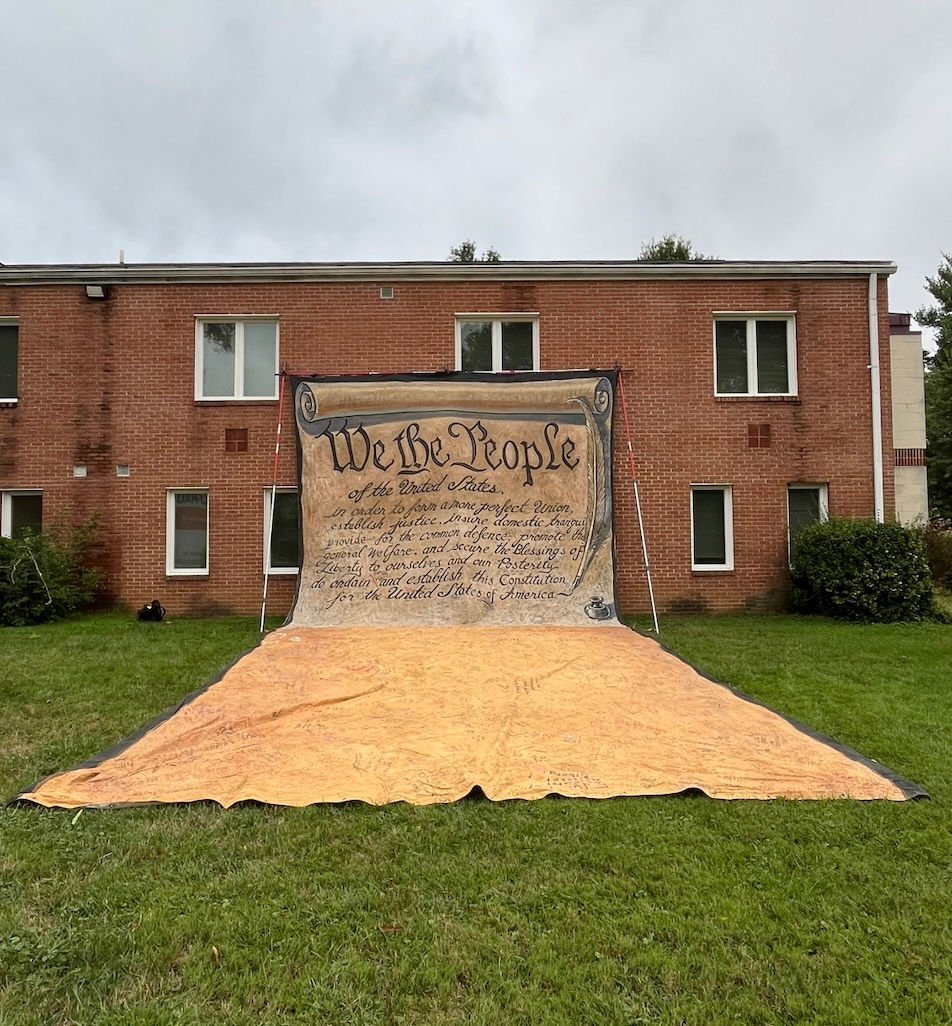
An idea hatched in March of 2025 seemed impossible at first. The We Are America founders, Maggie Bohara and MJ Tune, met at an anti-fascism tailgate, where they talked about Maggie’s idea for a march from Philadelphia to the U.S. Capitol. They were unsure if such an undertaking would be possible, but when one other friend joined the discussion they decided that “three people is all we need to start a movement,” according to MJ. So they took their idea and marched with it, reaching out through their networks and flooding social media platforms with the plan. They soon began hearing from many helpful advocacy and activist groups—including Laurel Resist and Indivisible of Howard County—that stepped in to help plan overnight stays and connect organizers to contacts in each area. Churches and homeowners along the proposed route offered space for sleeping and in some cases meals, activities, and community goodwill. The premise of the march, the tag line of which was “Creating Community and Defending Democracy,” was that a group of ordinary Americans can show Congress, the world, and each other how important democracy is by creating a “river of people” marching to halls of power to hand over various copies of the United States Constitution, which included an oversized We the People sign.
Much of the route was through rural Maryland, and the organizers weren’t sure what type of reception they would receive, but were pleasantly surprised by the positive response. “Maryland really came through for us,” said MJ. “The whole thing came together largely because of the Marylanders who stepped up to help.” MJ noted that people along the route were “generally supportive, although we have had a few hecklers along the way. But that’s okay: they can holler at us. It’s their right. We’ll holler louder when we reach the Capitol.”
The We Are America March began on September 6 from Independence Hall in Philadelphia, Pennsylvania, and ended on the steps of the Capitol in Washington, DC September 19. Over the course of those 14 days, approximately 400 marchers from all over the country participated in one or more days, or partial days, and about 50 made the entire trip.
Their website noted, “Over 400 patriots marched, with almost 50 marchers covering every mile of the 160-mile route, carrying a copy of the Constitution to hand directly to Congress. Anyone could join for a block, a day, or the whole way. At each stop along the march route, from yoga and singing in Delaware to a concert and camping in Cecil County, a flotilla in Havre de Grace—potlucks and potlucks and even more potlucks—we found a country united, resilient and yearning for connection and community. Each mile proved that brave Americans who value education, equality, diversity, freedom of speech, science, bodily autonomy, plain old compassion and empathy—we are everywhere. We are strong. We are united. We Are America.”
The March Comes to Laurel
On Constitution Day, September 17, the march route traveled through Columbia and to Laurel. The group stopped at Lake Elkhorn for a picnic lunch and a group photograph. Members of the Howard County “Indivisible” group came out to show their support and would greet the marchers again on the I-95-Gorman Road overpass. Additional marchers joined for this leg of the journey.
In Laurel, community members brought together by Laurel Resist waited for almost an hour to greet the marchers, huddling under a shelter at Alice B. McCullough Field on Montgomery Street to get out of the chilly drizzle that had started to fall. There were many handmade signs of support and American flags on hand.
Finally, the group of marchers was seen, escorted by a Laurel Police car. The Laurel contingent cheered and waved their signs as the marchers walked by, looking weary but seemingly energized by the support of the greeters. The group took a left onto Sandy Spring Road and arrived at their stop for the night: Laurel Presbyterian Church, where a giant scroll of the “We the People” preamble to the U.S. Constitution was on display. The artwork was created specifically for the March for America by an artist named Lucy Larkin. Part of the canvas scroll extended out onto the grass, and people were encouraged to add their signatures to hundreds of others who had met the marchers at previous stops.
Inside the church was a veritable feast, donated by community members and organizations and placed on tables that stretched the length of the hallway. The march participants joined community members for the potluck meal, which included local produce, vegan offerings, homemade side dishes and desserts. Then it was time to roll out sleeping bags and rest up for the next day’s journey.

2025: The “No Kings” Era Begins
Monthly nationwide protests against the policies of the second Trump Administration began shortly after he was inaugurated in January 2025. Most were small and locally based at first, but a coalition of various organizations—veterans groups, civil rights organizations, women’s groups, LGBTQ+ advocates, and more—formed around the goal of organizing nation-wide demonstrations, the first of which took place on April 5 and was titled “Hands Off.” At more than 1,400 locations across the country, an estimated 3–5 million protestors held signs saying things like, “Hands Off my Social Security benefits!” and “Hands Off our national parks!” to protest drastic cuts to federally funded programs. Many Laurel participants were among the 100,000 protestors in Washington, DC that day.

More importantly, a handful of Laurel residents who didn’t want to go to DC protested outside the U.S. Post Office on Main Street, which led to a renaissance of sorts for Laurel Resist. The group had not engaged in protesting for a few years, but had sponsored candidate town hall meetings in every city election since 2017 and partnered with Laurel Pride on several fundraising and community events. Sensing a growing passion in Laurel for activism, Laurel Resist joined with national-level coalitions to organize protests. The first held in Laurel was the “No Kings” rally on June 14, 2025. Knox says the No Kings organizers at first were reluctant to accept Laurel as an official location, suggesting that Laurel residents go to Washington, DC or Columbia instead. But Knox pushed back, stressing that “Laurel and Columbia are not the same, and we have a growing movement here.” Laurel was added to the official map, and an estimated 320 people gathered along Talbott Avenue by the library for the rally. “The enthusiasm really exceeded our expectations,” Knox said. “Everyone was so positive and it was a peaceful event, which is our goal.”
Following the success of No Kings, Laurel Resist went all-in, organizing local rallies in conjunction with nationwide events. A “Good Trouble” rally was held on July 17, commemorating the birthday of the late Congressman and civil rights icon John Lewis. There was a “Workers over Billionaires” protest on Labor Day, followed a few weeks later by the “We Are America” march which made a stopover in Laurel. The biggest Laurel event of the year, though, was the “No Kings 2” rally on October 18. Knox estimates that over 560 people participated at the Laurel library in that event, joining with over 7 million people countrywide.
October 18, 2025, marked the second nationwide No Kings protests, with over 60 planned rallies in Maryland alone and 2,700 nationwide. Local organizers again publicized, planned, and coordinated these events with local officials. In Laurel, the number of people who registered for the rally was four times greater than for the first No Kings event in June, according to Knox. She noted that organizers ran out of posterboard for a pre-rally poster-making opportunity at Emancipation Park Amphitheatre, which alone drew about 75 people.
In nearby Columbia, Indivisible of Howard County organized a pre-sign-wave rally at the Chrysalis in Symphony Woods, featuring music and speakers, including headliner U.S. Senator Chris Van Hollen. The senator stressed the importance of events like the No Kings protests, which he credited with helping to create community, letting people who are feeling isolated know they are not alone, and reinforcing the power of “We the People” by speaking out against authoritarian power grabs. Also speaking at the rally were Congresswoman Sarah Elfreth of the 3rd Congressional District and six individuals who had lost their federal jobs or faced uncertain futures because of the administration’s actions.
Following the rally, protesters marched to Governor Warfield Parkway and lined the street, stretching in both directions and filling the designated intersection for the sign wave. In addition to the prolific American Flags and signs, there were drums, tambourines, and boomboxes playing protest songs and dance music as well as a number of people in inflatable animal costumes. Organizers reported that at least 6,500 people participated in one or both of the Columbia events—which, as in Laurel, marked an large increase from the first No Kings rally in June.
Shortly afterward, Knox was already planning for the next rally in Laurel. She had heard from a lot of senior citizens with limited mobility living in the River Court Apartments and Selborne House who wanted to participate but needed transportation with their wheelchairs. She mused, “We will need to think about rides for the next one of these events.”
SIDEBAR:
“This is Why We March”
At the series of nationally organized protests held throughout 2025, local participants often would break into chants of “This is what Democracy looks like!” and “This is why we march!” While covering events in Laurel and Columbia, Voices of Laurel’s Angela Kozlowski and Diane Mezzanotte spoke to many of the demonstrators, asking them why they were protesting. Their responses revealed a wide variety of backgrounds, political persuasions, and platforms for which they were demonstrating.
Below is a sampling of what they told us, in their own words. Because many participants feared being “doxxed” or potentially targeted with violence, most quote attributions are by first name only.
“No Kings 2” Participants
Darleen said, “I don’t want to see [our] democracy fall. I was behind the Iron Curtain when there was an Iron Curtain.” She explained that, in the 1986-1987 timeframe, she had the chance to enter East Berlin while her husband was deployed to Germany. She went in with the chaplain from the U.S. military base. “It was sobering,” she said. “There were uniformed officers in front of every government building [in East Berlin]. There were a lot of government buildings.”
Mike was attending his first protest. Like others interviewed, he felt compelled to do something to support people being impacted. “I’m on [the social media platform] Bluesky, like everyone else. When I see what’s happening, I get emotional.” He said he’s not really impacted because he’s “a White guy.”
Dawn was out with her sister and son protesting on behalf family members who are federal employees. “I’m a registered Republican, but Independent-minded. They are breaking laws, Constitutional Laws.” Dressed as a green M&M to “bring joy and fun to the protest and as a nod to the inflatable green frog” [which has become a sign of resistance stemming from the wide use of inflatables, particularly frogs, in Portland, Oregon], she carried a basket of candy for rallygoers to enjoy.
Also among the 600 or so protesters was Raul Midon, a North Laurel resident and Grammy-nominated singer, songwriter, and musician. He was at the protest because, he said, “When all is said and done, I want to be on the right side of history.”
Jeffrey—a Black, disabled veteran, whose wife was currently deployed, and who was furloughed from his federal job with the Air Force—was attending the protest “for the two of us.”
Sister Mark, a Columbia resident, chose to come to the Laurel event “to help the town. Because small towns have a bigger impact. It’s breadth and depth, you know?”
Bridgett, who was at her second protest, said she was protesting to show that, “we do not approve of all this…what’s going on.” And she said, “[I] feel like I need to do something—continue to do something, like get involved with voter registration.” With her and holding up a sign made by a friend, also smiling and waving at the cars passing by, was Belvey. She was unhappy about “how the President is putting unqualified people in all the jobs where we need government experts—it’s like Covid. Covid was the example…I’m done with this. I am against what’s going on.” Belvey continued, “I’m the first person in my family [to be] born with full voting rights. My father was born in 1945 in Alabama. He did not have voting rights when he was born.”
Lynn, born and raised in Laurel but currently living in Columbia, is a veteran protester and came out to protest in Laurel because, she said, “I’m sick of it. I’m pissed off.” She planned to also attend the Howard County No Kings 2.0 event in Columbia later that day.
Amy Knox, leader of Laurel Resist, said, “The country belongs to ‘We the People,’ right? If you think the administration has gone too far, this is the place for you.”
Christine and her adult daughter, Alison, both first-time protesters, came to the Columbia sign-waving protest at the intersection of Broken Land Parkway and Governor Warfield Parkway. Christine said, “After seeing and hearing of the great turnout for the first rally in June, I decided to attend in October and was encouraged by my friends. We met [up] as a group, which helped to build a feeling of camaraderie.” Her impressions of the protest? She said, with a laugh, “I will definitely have to make a better sign for the next event! The sheer number of people, with their signs and flags, was very uplifting. There was such a positive vibe.” She said she plans to participate in future events, “with much improved props [and] hopefully with [all of] my adult children.”
The We Are America March
During a lunch stop at Lake Elkhorn in Columbia, several of the “We Are America” marchers—who walked from Philadelphia to Washington, D.C. in September—told us why they joined the walk, what it meant to them, and what they hoped would be achieved.
A woman named Toni, from Seattle, used all her vacation hours to join the march because of her “alarm” over things that are dividing the country. “I saw police brutality as a kid. I saw race riots, assassinations. We’ve come so far and now we’re back at square one. I saw an article about this march, and I thought, ‘It’s time to get up and get out again.’” Toni was marching with a stress fracture, incurred early on the journey; she said she walks for a while, then rides in one of the accompanying vans for a while, but she had no plans to quit. She praised the organizers. “They have worked tirelessly to keep us safe and keep us fed.” She said she was making friends among the marchers, and had found several examples of the “six degrees of separation” phenomenon. She also was starting to feel a reawakening of the faith she was brought up in. “For years, I shut all of that out. But I’ve met so many people of faith on this journey—generous people, from churches, opening their homes to total strangers—and things make so much more sense now.”
Among the marchers who heeded the call was a mother-and-son duo from the mid-West, ages 80 and 40, respectively, who wanted to remain anonymous. She wanted to do the march as soon as she heard about it, and began doing daily exercises to build strength and endurance. Inspired by his mother, the son went on a diet to lose weight so that he, too, would be healthier for the march.
Jim, from New Jersey, was wearing a Coast Guard hat. He said he had served many years in the Coast Guard reserve. “I’m walking because I believe in the rule of law and due process—neither of which is happening in our country right now. The President is violating the law and ignoring policies.” Acknowledging the country’s deep divides along political lines, Jim expressed hope that the march could influence “people in the middle” because “it’s all we can do between now and [the 2028 election]].”
Carly from Philadelphia had lived abroad in London and Dubai for several years, and said that she was “watching from afar” as politics in the United States took what she thought was a dangerous turn. “I felt disconnected and powerless to do anything other than call my representatives.” Once back in Philadelphia, though, she “found ways to join the fight.” She said she realized that the only way to change things back would be for “micro-level” organizers to step up. Since she was between jobs, childfree, and with good insurance through her husband, she felt “a responsibility to be on the front line of things,” so she became a full-time activist. “I feel like I’m walking in solidarity with [the other marchers], walking side-by-side with people of like mind.”
A local man, Jacob, from Howard County, said he was marching “because since the 2024 election, things are objectively awful.” Alongside his sister and her husband, Jacob had joined the marchers for the leg between Columbia and Laurel. He said that he had been protesting in Washington, D.C. at earlier rallies, but “I no longer feel safe there.”
As the lunch break ended, co-founder Maggie picked up a bullhorn and welcomed the day marchers to the group. She went over some of the ground rules, most of which focused on safety: medics with backpacks and security personnel were wearing neon-colored vests; group leaders holding poles with orange flags would be at the front and back of the group; a van was available if anyone needed to stop walking. Above all, she said, “We are a peaceful community march. We keep each other safe. Stay aware of what’s happening around you.”
A few hours later, a group of Laurel Resist members awaited the marchers’ arrival, huddled under a shelter at McCullough Field along Montgomery Street to escape the drizzle. Among them was a senior citizen named Toni, who said she had joined in many protests over the years, starting in college. “One that comes to mind is the 99-percenters who marched from New York to D.C. during the Occupy Wall Street protests,” she said. “I was very inspired by those marchers, and so when they got to Maryland, I clocked out of work and left for the day. People asked me why I was leaving, which wasn’t like me, and I said ‘I have to go show my support!’ So I drove down Route 1 until I saw them in Elkridge, and I got out to cheer them on.”
Toni continued, “People need to get involved. People have all kinds of excuses why they don’t. But look at me! I’m out here in the rain, and I’m no spring chicken.”
Angie Latham Kozlowski is a staff writer and member of the Board of Directors for the Laurel History Boys. In addition to her investigative reporting, her articles frequently spotlight Howard County.
Diane Mezzanotte is a staff writer and member of the Board of Directors for The Laurel History Boys. In addition to covering Laurel city municipal news, she also reports on all things from South Laurel.
Comments