

Whatever Happened to Winifred?

Updated: Feb 26
Laurel Noir is a series focused on historic crimes and the darker underside of our hometown.

The Avondale apartment building on Ashford Boulevard has been in the news over the past few months, with tenants seeking help from City officials for an ongoing rodent infestation that has forced several families to move. It’s surprising and unsettling, given the building’s pleasing appearance—built in 1987, the 11-story highrise sits behind a gated entrance and was fully renovated in recent years. It’s not the type of place you’d typically expect to have such a problem.
When I heard about the rat issue, I remembered a story that former Laurel Police Captain Carl DeWalt had mentioned to me over a decade ago. It wasn’t about rodents, but about a former resident of the Avondale who’d mysteriously disappeared. The case had made such an impression on DeWalt that he’d written down the details for future reference.
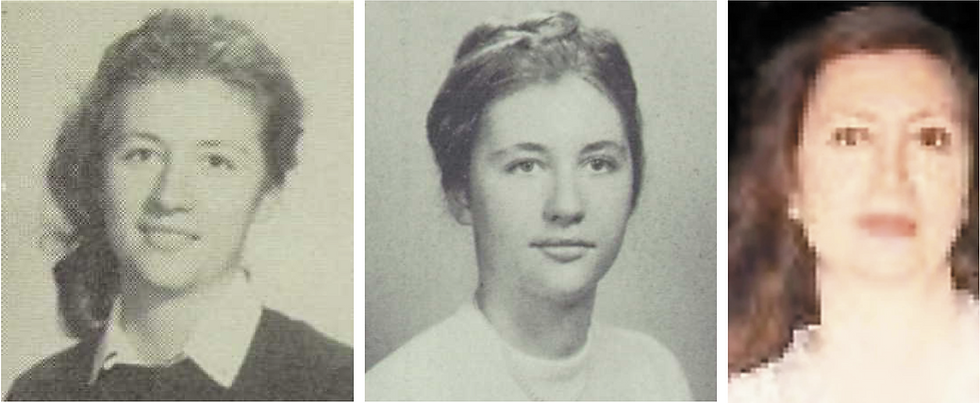
The details were sparse, but fascinating. Very little about the case was available online, either. In short, a 56-year-old woman named Winifred Matronia had last been seen on January 1, 2000—the day of the new millennium. However, she wasn’t reported missing until several months later; and when police checked her apartment at the Avondale, they found no signs of foul play. Her car was still parked there, her bank accounts hadn’t been touched, and all of her important documents were present. It was as though she’d simply vanished, but family members insisted that disappearing without any kind of notice just wasn’t in character for Winifred. Nonetheless, they speculated that she could perhaps have gone to Florida or the Caribbean.
Winifred, who lived alone in apartment 220, had recently retired from C&P Telephone Company. She’d never married and didn’t have children. She was said to have had a heart condition of some kind, which escalated the search status for her to a missing and endangered person. At the time of her disappearance, Winifred was listed as White, approximately 5'9 and 140 pounds, and with a particularly distinct characteristic—her left eye was blue and her right eye was brown.
Over the years, there have been no reported sightings of, messages from, or banking activity associated with Winifred. Nor has a body ever been identified.
A Mysterious Christmas Card
Through a Freedom of Information Act request, I was able to obtain a number of pages from the Laurel Police Department’s case file. While the new information did not contain a proverbial smoking gun, it did provide some intriguing new details.
First, it corrected the date of her disappearance. Winifred was actually last seen on January 11, 2000—by police officers, no less—when she visited the Laurel Police Department (at that time still located on C Street) to report a suspicious letter. Something about a Christmas card she’d received had unnerved her, because she didn’t recognize the signature of the person who’d mailed it and didn’t know who it was from. There was nothing sinister about the card according to the officers who interviewed her that afternoon; and by her own admission, Winifred couldn’t think of anyone who might want to harm her. The officers, who had no cause for concern when Winifred left the police station that day, had no way of knowing it would be the last time anyone would see or hear from her again.
A Strange Odor
Just over two months later, Laurel Police received a phone call on March 26 from a manager at the Avondale. She was calling to report “a strange odor” coming from Winifred’s apartment and stated that she had been unable to contact the tenant. Former Laurel Police Sergeant (and Voices of Laurel columnist) Rick McGill was one of the officers who investigated that day. They found the apartment to be secure, and no odor was detected. The Avondale manager who had made the complaint concurred.


McGill’s report stated that the apartment “contained a few items of furniture and some other items of property still in boxes, but did not appear to have been lived in at all.” The telephone was working, which McGill noted indicated that the service was still being paid—although a former C&P Telephone Company employee I spoke to shared that many colleagues received free service “in case they needed to be reached at any given time.”
The electricity was another matter, however, and had been turned off. There was spoiled food in the freezer, which may have been the source of the earlier odor.
The next Laurel Police Department involvement came on July 25, when Winifred’s aunt phoned to request a wellness check on her niece, whom she had been unable to reach. Officers visited Matronia’s apartment again that day, and after gaining access from the property manager, they found the home to be in identical condition as when they’d last checked it in March: the power was off, food was rotting in the refrigerator, and there was nothing to indicate any foul play. Nor were there any clues as to where Winifred might have gone.
The property manager, who had not seen Matronia for several months, vaguely remembered having had a conversation with her in which Winifred had stated an intention to travel in recent weeks, but unfortunately she could not recall any specific details.
On August 7, Winifred’s aunt visited the apartment once more. There was still no sign that Winifred—or anyone—had been there. She stated to police that Winifred had a younger sister named Linda in Oregon who would be able to provide more information for a missing persons report, which she did that afternoon by telephone. Linda explained that she’d received a letter from Winifred in January, and that was the last contact she’d had with her.
A Person of Interest
Linda provided police with an interesting story about a man from Winifred’s past that she had reconnected with at a recent high school reunion. According to both Linda and her aunt, the man had convinced Winifred to invest the bulk of her retirement money—a lump sum payment she’d received from C&P Telephone Company of approximately $124,000—in a computer company that he owned. Both relatives advised her against it, but Winifred had assured them that she knew what she was doing. Linda made it clear that she suspected that this man had played some role in her sister’s disappearance, one way or another. She reiterated that it was very out of character for Winifred to go without communicating for any length of time, and she voiced concern for her sister’s safety.
Laurel Police detectives had their work cut out for them. Aside from Winifred’s complaint about the mysterious Christmas card, they had little to go on. Their records did show, however, that her car had been towed on July 19 from 14902 Fourth Street. Showing expired tags, it had been reported as an abandoned vehicle by property management. That location is interesting in that it’s behind the Avondale building, and not in the gated primary lot where a resident would typically park. It raises the question of whether or not Winifred was the person who last parked it. After being towed, the car sat unclaimed in the impound lot of Hofmann Brothers Towing, where police waited in hopes that someone might eventually inquire about it. No one ever did.
More than three years passed with no reported sightings of or contact from Winifred. On October 6, 2003, Linda spoke with police and revealed that she had recently been in Maryland and confronted the suspect herself, letting him know that she held him responsible for her sister’s disappearance. He denied any involvement, and only said that he hoped Winifred was “having a good time wherever she was” before abruptly ending the conversation.
A Dead End
By August 2005, the case had been transferred to another LPD investigator. In 2009, police briefly lost contact with Linda, who had moved across the country without forwarding her new information. She resumed contact in January 2010 as the case reached its 10-year milestone. After a full decade and vigorous re-examinations of the case, police were sadly still no closer to learning what had happened to Winifred. There had been no contact, no sightings, no financial activity, and no unidentified body matches.
The last page of the LPD case file contains only three sentences, and they hit like the ending of a mystery novel that misses the mark and makes you want to throw the book across the room:
"In February of 2012, the missing person in this case, Winifred Matronia, was declared legally deceased. This case was previously suspended, as the only known offender, (name redacted), died in February of 2011. A copy of this report will be forwarded to communications for the purposes of removing Matronia from NCIC as a missing person."
There are no details about any investigation into the “only known offender,” but evidently his death was a significant enough event to suspend the case and declare Winifred Matronia legally deceased. I can’t imagine that it brought her family much closure, however, as it still doesn’t answer the questions of what actually happened: where did she go? How did she disappear? Why has her body never been located?

Mystery Man
Despite the redactions in the police reports, identifying the man from Winifred’s class reunion wasn’t difficult. In one instance, the black box used to cover his name didn’t fully obscure it; it afforded just enough detail to show the number of characters in his first and last names, as well as a hint to key letterforms including straight and rounded strokes. Using her 1961 Bladensburg High School yearbook, I combed through the seniors section and narrowed down to two possible names which fit the criteria. A quick search revealed that one of them—just like the suspect—had passed away in February 2011.
As he was never charged with a crime, I’m not going to name him here. What little I’ve found about him thus far shows that he was a career Navy man who’d served two tours in Vietnam, and at the time of his death he’d been married for 39 years. I also don’t yet know the circumstances of his death, but he was only 68 years old. Curiously, his wife died at age 62 less than four months before he passed away. Both are buried at Arlington National Cemetery. Whatever connection he may have had with Winifred’s disappearance is likely buried, as well.

Another Winifred Matronia?
The name “Winifred Matronia” appears in the November 12, 1980 issue of the Florida Today newspaper. It’s a story as odd and memorable as this one, but it’s not the same person—it was her mother.
The elder Winifred was 64 years old at the time and not only survived what was described as a catastrophic accident in which the 1951 Studebaker truck she was driving “flipped end over end several times, landed upside down, and caught fire,” she was unscathed. The good samaritan who pulled her from the truck before the flames could reach her even had to physically restrain her from running back to the burning truck. “She was having a fit,” he said. “She wanted to go back and get her purse.”
Winifred’s mother eventually passed away in 1987, and her father, John, a decade later. They’re buried at Florida National Cemetery in Bushnell.
Winifred’s disappearance in 2000 came just over three years after the February 1997 death of her father, and her parents’ connection to Florida could explain the belief that she may have been planning to travel there. Of course, it doesn’t explain why she may have chosen to leave everything behind.
So Many Questions
So, what could have happened to Winifred Matronia? Did she make a conscious decision to disappear? And if so, why?
In the pre-9/11 era, before airport security was exponentially increased, it was certainly easier to do so. She could presumably have taken a taxi to the airport and paid cash for a one-way ticket somewhere to start a new life anonymously. The $124,000 retirement package she had at the time was equivalent to $233,293 in today’s economy. Assuming she had ample cash on hand, it’s possible that she could have voluntarily left. But according to her relatives, it would have been very much out of character. Her bank and credit card accounts were also reportedly untouched, which makes it less likely that she could have pocketed enough cash to fund and sustain a new identity.
Also, did she still even have a substantial nest egg? Her relatives claimed that the man from her class reunion had “convinced her to invest the bulk of her retirement money in a computer company which he owned.”
Did this man kill Winifred? And if so, for what reason? Did things go badly after she invested? Was there more to their relationship that perhaps threatened his marriage? We can only speculate.
I keep going back to the last reported sighting of Winifred—her trip to the Laurel Police Department to complain about that “suspicious” Christmas card. Something about that just seems abnormal. It suggests to me a degree of paranoia—it’s very unusual to go to the police because you received a Christmas card from someone you didn’t recognize. I’m not judging—just observing. It strikes me as a possible sign of a mental health issue that went unnoticed.
How she disappeared is only part of the question; the bigger question is where is she now? If she’s alive, she would be 81 years old. If she’s dead—and authorities did declare her legally deceased in 2012—why hasn’t her body been found?
In 2009, her dental records were entered into the National Missing and Unidentified Persons System (NamUs), a national centralized database for missing, unidentified, and unclaimed person cases. NamUs helps investigators match long-term missing persons with unidentified remains to resolve cases and bring resolution to families. Of the many Jane Doe victims that have been recovered, none match Winifred.
Does the Building Hold the Answer?
Whether she was killed, took her own life, died by accident, or from natural causes, the idea of Winifred just having vanished is what’s most unsettling about this case.
The recent news about the rodent infestation at the Avondale apartments likely has no bearing on this at all, but I can’t help being reminded of the disturbing story of Elisa Lam from a few years ago.
Elisa was a young Canadian tourist staying at the former Cecil Hotel in downtown Los Angeles. She had gone missing on February 8, 2013, and in an effort to locate her, police released security camera footage from a hotel elevator which showed her behaving erratically—appearing to be hiding from an unseen pursuer while making unusual body movements. It’s easily one of the most disturbing pieces of video footage you’ll see, especially with it being the last known sighting of the missing woman.
Later that week, hotel guests began complaining about a drop in water pressure, as well as the water being discolored and having an unusual taste. On February 19, a hotel maintenance worker made the grisly discovery—Elisa’s body was found floating in one of the 1,000-gallon water tanks on the roof of the hotel. It was later determined that Lam, who suffered from bipolar disorder and had skipped her medication, had somehow crawled into the tank herself, where she accidentally drowned. The case was the subject of the 2021 Netflix documentary series, Crime Scene: The Vanishing at the Cecil Hotel.
Again, it’s highly doubtful that a current rodent problem would be indicative of the presence of a dead body from a quarter of a century ago. But it does beg the question of just how thoroughly the sprawling Avondale high rise has been checked over these years—in all the nooks and crannies, behind the walls, in the elevator shafts... It’s a disturbing thought, but what if Winifred Matronia never actually left the building after all?
Richard Friend is a founding member of The Laurel History Boys, and creator of LostLaurel.com.
Comments